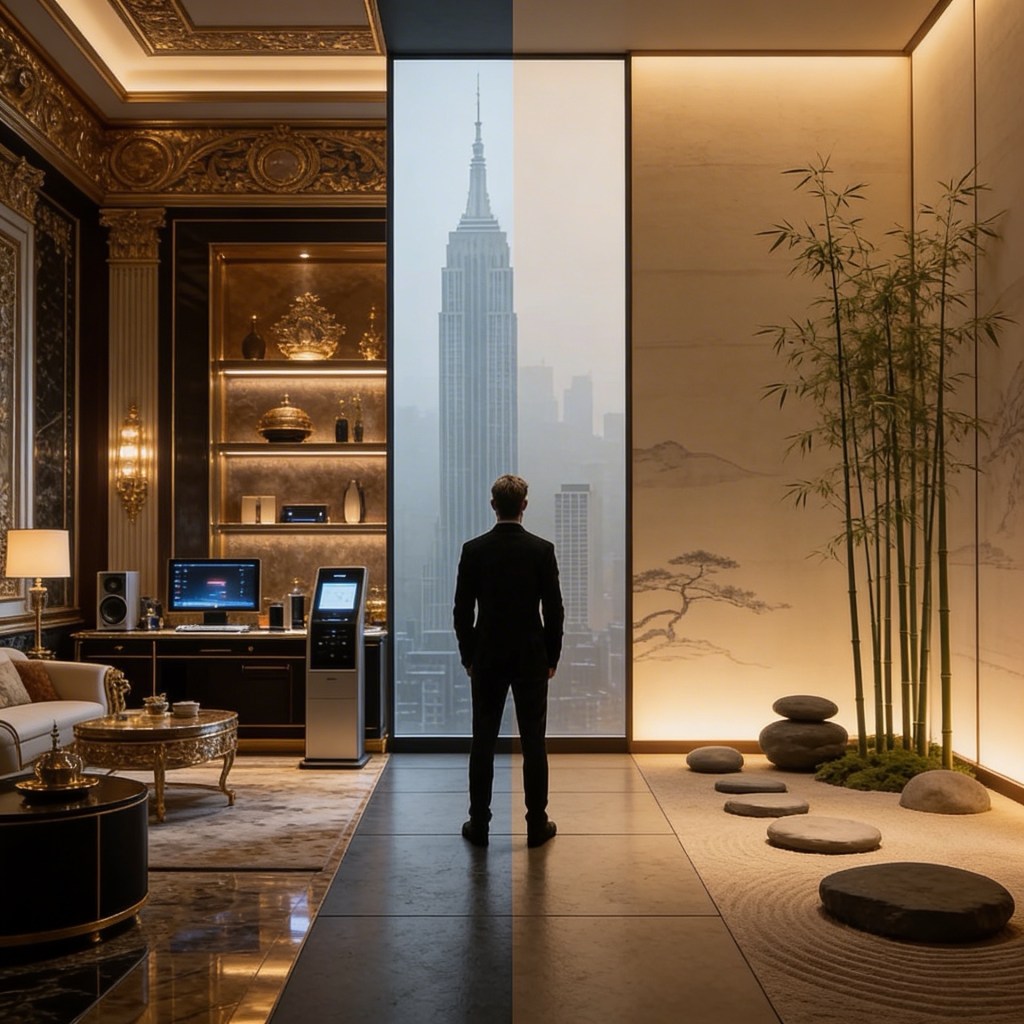
Extreme luxury often looks like a world apart, a world of beauty, control, rarity, and silence. But behind that polished surface lies a deeper question: is luxury really about pleasure and taste, or is it also a way of protecting ourselves from fear, lack, and uncertainty?
Luxury as Protection Against Lack
At its core, the pursuit of luxury is often less about pleasure than about safety. Most people do not dream of wealth simply to own beautiful things. They want to be protected, from need, from instability, from humiliation, from the fear of falling behind. For the ultra rich, luxury can become more than comfort or distinction. It becomes a visible confirmation that they are now safe from what they once feared most.
Excess itself has a psychological function. The larger the house, the rarer the object, the more exclusive the experience, the stronger the message seems to become: nothing can reach me now. In that sense, luxury is not always just vanity. It can be a way of creating distance from vulnerability, a material shield against insecurity.
But that kind of reassurance is fragile. It depends on external signs, and external signs never fully calm an internal fear. They soothe for a moment, then demand renewal. That is why luxury can easily turn into a loop, not because beauty has no value, but because material abundance is often asked to do more than it can actually do.
Spinoza, Desire, and the Weight of Experience
This is where a Spinozist reading becomes interesting. Spinoza reminds us that human beings do not desire in a vacuum. We like to believe that our choices are fully free, that we simply decide what we want. Yet our desires are shaped by causes we often do not fully see, our upbringing, our fears, our frustrations, our memories, our social environment, and the experiences that formed us.
Seen from this angle, the desire for luxury is rarely just a personal preference. It is often the sum of what we have lived. A childhood marked by scarcity, a family culture obsessed with appearance, moments of exclusion, comparison, silent humiliation, the need to prove oneself, all of this can shape what later appears as ambition, taste, or even refinement.
This does not mean that luxury is inherently shallow or false. It means that it should be read with nuance. What looks like pure personal choice may also be the continuation of an old emotional logic. Sometimes we do not pursue luxury because we truly love it, but because it has become, in our mind, the visible form of security, recognition, and worth.
Social Pressure, Endless Material Pursuit, and the Question of True Luxury
The obsession with luxury that we see today, especially on social media, is not created from nothing. Social platforms amplify desire, but they do not invent it. The pressure often begins much earlier, within the family, in the values we absorb, in what is praised, admired, or associated with success. Later, life experiences add more layers, comparison, frustration, social pressure, and the fear of not being enough.
Social media then turns all of this into a permanent performance. Luxury becomes not only something to own, but something to display. It becomes a language of validation. The danger is that this creates an endless pursuit. If material acquisition is meant to heal insecurity, then no object is ever enough. One purchase leads to another, one symbol of success demands a stronger one, and the cycle continues.
This is where the question becomes more human than economic. What if true luxury is not endless accumulation, but inner stability? A quiet mind. A real connection to nature. The ability to accept what one has. Not living in fear of tomorrow. Being surrounded by family and friends. Staying connected to one’s values, and even to the simplicity of childhood, before life turned everything into comparison and proof.
Conclusion
The luxury of the ultra rich is not simply an escape from reality, nor merely a celebration of beauty. It can be a form of protection, a response to fear, and a continuation of everything a person has lived through. That is why the pursuit of luxury can become endless, because material wealth cannot fully resolve emotional insecurity. In the end, perhaps the rarest form of luxury is not what we buy, but the peace that begins when we no longer need possessions to reassure us about who we are.
 bori_space
Leave a comment